|
Click
here
if you would like to Contribute or send a feedback.
Click
here to read more about the History
of Karnataka.
The
decline of the Satavahana power in the Deccan was followed
by the rule of many lesser dynasties like the Chutus, the
Abhiras and the Ikshvakus during the third century A.D.
the Karnataka area, however emerged out of this welter of
political confusion in the following century, when the Kadambas
of Banavasi rose to prominence. In fact, they were the political
and cultural heirs of the Satavahanas in Karnataka. Some
scholars believe that they were related to the Satavahanas,
as they described themselves as Brahmanas, and as belonging
to the Manavya Gotra, and as Haritiputra. Politically, they
were the contemporaries of the Guptas, the Vakatakas, the
Pallavas and the Gangas.
ORIGIN
OF THE KADAMBAS:
Prof.
G. M. Moraes, the author of 'The Kadambakula' (1931) has
rightly pointed out that "The origin of the Kadamba family
is enveloped in the mist of legendary tales". According
to one account, the originator of this family was one Trilochana
Kadamba who had three eyes and four arms. He was born out
of the sweat of Siva, which had fallen under a Kadamba tree,
hence his name Kadamba. His son was Mauryavarma, the founder
of the Kadamba dynasty.
Another legend is to the effect that Mauryavarma himself
was the son of Siva and the Earth Goddess, and was born
under a Kadamba tree. As he also had a third eye on the
forehead, the crown had to be tied to his knee!
The Grama Paddhati, a Kannada work dealing with the history
of the Tulu Brahmanas, narrates a story that after Parasurama
created the Haiga and Tulu countries, Siva and Parvati came
to Sahyadri, and there a child was born to the divine couple.
Since the birth took place under a Kadamba tree, the child
was named Kadamba, and was placed in charge of the Sahyadri
region. Mauryavarma belonged to this family and he made
Banavasi his capital.
There
are a few more versions about the origin of the Kadamba
family. The Devagiri Plates of Krishna Varman I connect
the Kadamba family with the Nagas. Another account speaks
of the Nanda origin of the Kadambas. There is also a Jain
tradition according to which Mauryavarman was the son of
the sister of Ananda Jinavritindra. These legends do not
in any way put the speculations to rest; and they cannot
explain the origin of the Kadamba family. The only plausible
account of the origin of the Kadamba dynasty is available
in the Talagunda pillar inscription of Santivarma. According
to Dr. B. L. Rice, " It gives what appears to be a realistic
and true account of the Kadamba line of Kings, free from
numerous legends that are current regarding it". It describes
at length the circumstances that led to the founding of
the Kingdom by Mayurasarman, who by his Kshatriya demeanour
came to be known as Mayuravarma.
MAYURAVARMA:
According
to the Talagunda Pillar inscription, the founder of the
Kadamba Kingdom was one Mayurasarma who belonged to an orthodox
Brahmana family which derived its descent from Hariti and
belonged to the Manavya Gotra. The family was deeply devoted
to the Vedic studies and the performance of Vedic sacrifices.
The Kadamba tree that grew near their house gave the family
its name. The Gudnapur inscription, recently discovered
by Dr. B. R. Gopal, tells us that Maurya's grandfather was
Virasarma, who also acted as his preceptor, and that Maurya's
father was Bandhushena who developed the character of a
Kshatriya.
The
Talagunda inscription narrates how Mayurasarma proceeded
to Kanchi, along with his Guru Virasarma to prosecute his
Vedic studies at a Ghatika. There, owing to some misunderstanding
between him and a Pallava guard, a quarrel arose in which
Mayurasarma was humiliated. In high rage, the Brahmana discontinued
his studies, left Kanchi, swearing vengeance on the impudent
Pallavas, and had recourse to arms. The inscription does
not miss the opportunity to provide a dramatic effect to
the event, and says: " with the hand dexterous in grasping
the Kusa grass, the fuel and the stones, the ladle, the
melted butter and the oblation vessel, unsheathed a flaming
sword, eager to conquer the Earth". An open rebel against
the Pallava authority and arrogance, Mayurasarma collected
an army and routed the Pallava officers guarding the frontier
and occupied the area of Sriparvata (Srisailam). He then
subdued the Brihad-Bana and other kings and collected tributes
from them. Unable to tame the power of Mayura, the Pallava
rulers thought it wise to compromise with him and acknowledged
his sway over the territory from the Western Ocean to Prehara.
Politically, the success of Mayurasarma should be viewed,
as scholars like Dr. G. M. Moraes and Prof. K. A. Nilakanta
Sastri have pointed out, in context of the confusion that
prevailed in the South after the invasion of Samudragupta.
Mayura was successful in exploiting the situation to his
advantage. It has also been argued that the whole event
was a reflection of the revolt of the Brahmanas against
the Kshatriya misrule and tyranny. In fact, Mayura, after
he successfully defied the Pallava authority, preferred
to change his surname 'Sarma' to 'Varma', which was indicative
of the Kshatriya status.
The political career of Mayura did not stagnate after he
secured a base for his ambition. He soon defied the authority
of the Pallavas and proclaimed his independence. His Chandravalli
record says that he subdued the Traikutas, Abhiras, Pallavas,
Pariyatraka, Sakasthana, Mokhari, Punnata and Sayindhakas.
Pariyatraka was the region of the Western Ghats between
the Aravalli and the Vindhyas. Sayindhakas were the Sendrakas
governing a part of the Shimoga area while Punnata was the
Heggadadevanakote region. Dr. P.B. Desai thinks that though
it is not improbable that Mayurasarma came into conflict
with some of these kings, it is doubtful he went as far
as the Sakasthana and Mokhari which are identified with
the territories of the Sakas of Ujjaini and the Maukharis
of Rajasthan. Dr. K. P. Jayaswal is convinced that Mayurasarma's
Kingdom was confined to Karnataka. However, it is said that
in commemoration of his spectacular victories, Mayura performed
the Aswamedha sacrifice to advertise his sovereignty.
We are not able to establish Mayura's chronology with any
certainty. If we accept the view that his activities began
after Samudragupta's South Indian expeditions, we may tentatively
say that Mayurasarma came to the throne in C. 350 A. D.
and ruled for about two decades. His prowess and organizing
abilities merit admiration. He was a Dvijothama to start
with, but transformed himself into a redoubtable and successful
warrior and an Empire-builder. He was convinced that a little
toughness was needed to survive in the harsh world around
him, and that mere piety and effete goodness were not adequate
qualifications for a successful man of action.
THE
SUCCESSORS OF MAYURA:
Mayurasarma
was succeeded by his son Kangavarma in C.365 A.D. perhaps
he had to suffer the discomfiture of losing a portion of
the Kuntala to the powerful Vakatakas. His son and successor,
Bagiratha (C. 390-415) is said to have retrieved the losses
of the family, although the Vakataka inscriptions do not
substantiate this proud claim. His son Raghu ( C.415-435)
succeeded him, and after a hectic rule is said to have lost
his life in a contest against the Pallavas. As he died childless,
his younger brother, Kakustha Varma (C. 435-455), who had
functioned as a Yuvaraja, came to the throne. Dr. G. M.
Moraes thinks that under him the " Kadamba Empire reached
the acme of its greatness". The Talagunda inscription hails
him as " the ornament of the Kadamba Family". He is described
as a " formidable warrior" who defied every danger. His
political influence is reflected in the fact that he was
able to conclude matrimonial alliances with many prominent
ruling families of the day. The Talagunda inscription states
that he maintained such relationship with the imperial Guptas.
It is possible that Kakusthavarma's daughter was married
to Kumara Gupta's son, Skanda Gupta. His another daughter
Ajjhitabhattarika by name, was married to the Vakataka ruler,
Narendrasena. Similar alliances were concluded with the
Bhatari chief, the Alupas and the Gangas, thus extending
the Kadamba influence among a number of ruling powers. The
Halsi plates and the Hamidi inscription refer to the abilities,
industry and magnanimity of Kakusthavarma, and bestow eloquent
tributes to his greatness.
After Kakusthavarma, the Kadamba Kingdom was divided between
his two sons, Santivarma and Krishna Varma I, who commenced
their independent rule simultaneously at Banavasi and Triparvata
respectively. Santivarma, who was associated with his father's
administration, had a brief reign, and was succeeded by
his eldest son, Mrigeshavarma, in C. 460 A. D. he crossed
his sword against the Gangas and the Pallavas, married a
princess from the Kekeyi family, and earned a reputation
as impartial administrator of justice. After his death in
C. 480 A. D., his brother Shivamandhativarma acted as a
regent to the former's son Ravivarma who came to the throne
in C. 485 A. D. his rule was marked by a series of clashes
against the Triparvata branch of the family, and also against
the Pallavas and the Gangas. He is also credited with a
victory against the Vakatakas, which extended his Kingdom
as far north as the river Narmada. After his death in C.
519, he was succeeded by his son Harivarma, whose brief,
undistinguished rule was brought to an end by Krishnavarma
II of the Triparvata line. But, by then, the Kadamba power
had been considerably weakened by many political and economic
forces, and was soon eclipsed by the growing power of the
Chalukyas and the Pallavas.
The Triparvata branch of the Kadambas was founded by Krishnavarma
I, who was an energetic and successful ruler, who performed
the Aswamedha sacrifice. His capital Triparvata is identified
as Halebid by Dr. G. M. Moraes and as Murgod in Belgaum
district by K. P. Pathak. The latter is more probable. After
Krishnavarma I, rulers like Vishnuvarma, Simhavarma and
Krishnavarma II managed the affairs of the Triparvata branch.
They fought wars against the Banavasi branch, which must
have led to considerable exhaustion, and that in turn, led
to the decline of the Kadamba power.
ADMINISTRATION:
The
Kadamba rulers managed a kingdom which approximately covered
the area of the present Belgaum, North Kanara, Chitradurga
and Bellary districts. In administration, the Kadambas,
by and large, imitated the Satavahanas. The lofty ideals
of administrations expounded in the ancient texts were expected
to provide the guidance to the rulers. They assumed such
titles as 'Dharmamaharaja', 'Vaijayantidharmamaharajadhiraja',
or 'Vedangavidyavisharada'. The Kadamba administration witnessed
an important development in the form of an increasing influence
of the office of the Yuvaraja. Sometimes, he assisted the
king in the administration; sometimes he would look after
the affairs of some distant provinces. It certainly provided
the necessary training ground for the heir-apparent and
made for a smoother transfer of power.
Dr. G. M. Moraes is of the opinion that the King was assisted
in administration by a cabinet of five ministers like Pradhana
or Prime-minister, Manevergade or the steward of the household,
Kramukapala or the betel-carrier, Tantrapala or the minister
in charge of the external affairs and the Sabhakarya Sachiva
or the secretary of the Council. The inscriptions refer
to other officers like the Sarvakaryakartha (the Chief Secretary),
the Rahasyadhikrita(Private Secretary), the Rajjukas or
the officers in charge of revenue, and the Lekhakas or writers.
Dharmadhyaksha was perhaps the Chief Justice. The ministers
or the officials were appointed on the basis of their merit
and qualifications, as the efficiency of the Government
largely depended on them.
The
kingdom was divided into provinces (mandalas), which were
entrusted to governors who were responsible to the King.
For administrative convenience, cities like Halsi, Triparvata
or Uchchangi were made secondary capitals although Banavasi
had been the Headquarters of the Kadamba authority. The
provinces were divided into Vishayas or districts, which
were further sub-divided into Mahagramas or Deshagramas,
resembling a hobli. The village was the lowest unit of administration,
and was under a Gramika. The village enjoyed a great deal
of autonomy.
The
Kadamba taxation was generally based on the principles laid
down by the Smritis. Land tax was not more than one-sixth
of the total produce and was the main source of revenue
to the State. Inscriptions speak of taxes like Perjunka
(levy on loads), Bilkode (sales tax), Kirukula (levy on
retail goods on transit), taxes on betel leaves and many
other professional taxes on the barbers, oilmen, blacksmiths,
carpenters and so on.
The
judicail administration in the Kadamba period was marked
by leniency and moderation. Capital punishment was not awarded
to those guilty of murder, they were merely fined. The judicial
procedure, however, seemed to have been simple and sometimes
even crude. Ordeals were often resorted to. Justice was
mostly a matter of local concern, although the kingdom had
a number of courts, a Dharmadhyaksha or Chief Justice, and
of course, the King himself, who was the highest Court of
appeal. Although details of the army administration are
scanty, it is probable that the Kadamba rulers gave adequate
attention to the army matters. Officers like Dandanayaka
and Senadhipati are referred to in the inscriptions. The
Chaturangabala was the basis of the army organization. The
Kadambas seem to have enjoyed the Guerilla technique of
warfare, and must have used it to great advantage against
the Pallavas. Their kingdom had a number of strong, impregnable
fortresses, which must have contributed to their militayr
strength.
SOCIAL
AND ECONOMIC CONDITIONS:
The
Kadamba society was organized on the traditional basis of
Varnashramadharma. But it is possible that the entry of
the foreign elements into the Deccan and the resultant admixture
of races and castes which we notice in the Satavahana period
continued during the Kadamba rule, and it must have disturbed
the social order. The tradition has it that Mayuravarma
imported Brahmanas from Ahichchatra in Rohilkhand and settled
them in Tulunadu. The Kadamba society did not, however show
signs of disharmony among various castes. Women continued
to enjoy considerable freedom, and they actively participated
in social, cultural and political activities.
The
Kadamba economy was primarily agricultural. There are references
in the inscriptions to the classifications of lands on the
basis of fertility, and also to the survey and measurement
of lands. Different types of land tenures like individual
ownership and joint ownership are also referred to. The
Kingdom could boast of several flourishing cities like Banavasi,
Halsi or Belligami. Inland trade was brisk and was in the
hands of Virabhanajigas. Overseas trade contact was maintained
with the Arabs as with a few Western countries. Honnavar,
Mangalore, Goa or Ankola were the flourishing ports in the
Kingdom. The Kadambas introduced new traditions in coinage:
they replaced the punch-marked coins by the Padma Tankas,
which became the model for the South Indian Varaha.
EDUCATION
AND RELIGION:
Education,
both religious and secular, was promoted in the Agraharas
and the Ghatikas. The Jaina and the Buddhist monasteries
also worked to provide the educational base to the society.
The Ghatikas provided platforms for religious disputation,
in which the scholars could excel themselves to merit the
title ' Ghatika Sahasa'. The Agraharas, like the Belligami
Agrahara or the Talagunda Agrahara became famous as residential
universities, which attracted students from far and wide.
Prakrit
had the status of an official language under the early Kadamba
rulers. But by the time of Kakusthavarma, Sanskrit came
to be increasingly adopted. Kannada too was assuming greater
importance by the 5th century A.D. as evidenced by the Halmidi
inscription.
The
Kadambas were the followers and the champions of Brahmanical
religion. They were the enthusiastical performers of Vedic
sacrifices, and Madhukeshwara of Banavasi was perhaps their
family deity. But then, they also patronised Jainism and
often so liberally that some scholars thought them to be
Jains. Pujyapada, Kumaradatta, Niravadya Pandita and many
other Jain saints are mentioned in the Kadamba records.
There were Jain monasteries at Belligami, Kuppalur and other
places. Buddhism too was a religion in the Kadamba period.
Hieun-Tsang in the 7th century describes Banavasi as having
about 100 Sangharamas wherein lived 10,000 priests of both
Mahayana and Hinayana sects. Archaeological excavations
in the region have confirmed this information. However,
Saivism seemed to have been popular, and the inscriptions
refer to the Saiva sects like the Goravas, Kapalikas, Pasupatas
or Kalamukhas. Vaishnavism too must have enjoyed considerable
popularity. In short, the Kadambas ruled over a region which
presented an interesting mosaic of religions and religious
sects.
ART
AND ARCHITECTURE:
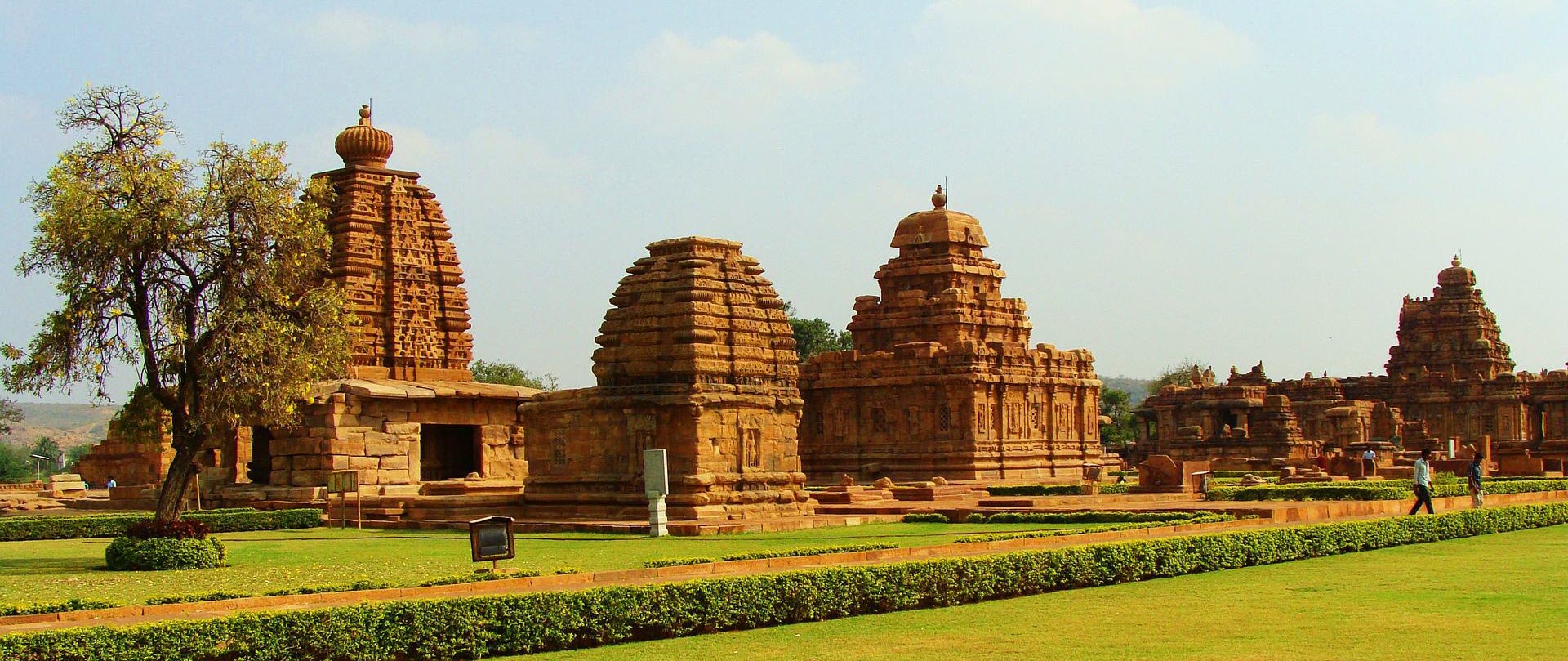
Although
the Kadamba monuments are not known either for their magnificence
or their profusion, they have been regarded as one of the
foundations upon which the Karnataka architecture is based.
The earliest monument of the Kadamba period, according to
Dr. G. M. Moraes, is the Jaina Basadi at Halsi, which is
said to have been built by Mrigesavarma. It is a simple
structure which consists of a Garbhagriha and an Antarala,
but not a Mukhamantapa. Here again, the Antarala is wider
than the Garbhagriha. The walls are clumsily raised and
the granite stones are roughly hewn. The Pranavesvara temple
at Talagunda presents a certain measure of refinement: the
Pillars are moderately ornamented with geometrical designs
and the lintels of the doorways have some floral designs.
The temple is said to have been rebuilt by Prabhavati, the
Queen of Mrigesavarma, and her son, Ravivarma. The Madhukesvara
temple at Banavasi and the Adimadhukesvara temple at Hale-Banavasi
belong to the early Kadamba period. So were the Kadambesvara
and Srikantesvara temples in the neighbourhood of the Madhukesvara
shrine.
The
Kadamba style of architecture is further reflected in the
group of temples at Kadaroli in the Belgaum district. The
Sankaradeva temple presents a square Garbhagriha surmounted
by a pyramidal Vimana, which rises in horizontal stages
resembling steps. The Hattikesvara temple at Halsi shows
yet another stage of the development of the Kadamba architecture,
as it has perforated screen windows on either side of the
doorway. The Pillars attain greater variety and refinement
in the Kallesvara temple at Halsi as well as in the Somesvara
temple. The monuments of Yalavatti, of which a Jaina temple
is most important, shows the additional sophistication introduced
into the Kadamba architecture. Similarly, the Ramesvara
temple and the Varanarasimha temple at Halsi show the myriad
facets of their architectural tradition. Dr. K. V. Soundara
Rajan speaks of three Brahmanical caves at Arvalem in Goa
as belonging to this period. They are unique because they
are hewn out of laterite rock.
The
contribution of the Kadambas to the architectural heritage
of Karnataka is certainly worthy of recognition. Dr. G.
M. Moraes believes that the Kadamba style can be identified
and that it has a few things in common with the Chalukyan
and the Pallava styles. They also drew from the architectural
tradition of the Satavahanas. It has also been pointed out
that in architecture and sculpture, the Kadambas contributed
to the foundation of the later Chalukya-Hoysala style.
Mr.
Arthikaje
Mangalore.
Click
here if you would like to Contribute or send a feedback.
Click
here to read more about the History
of Karnataka.
|