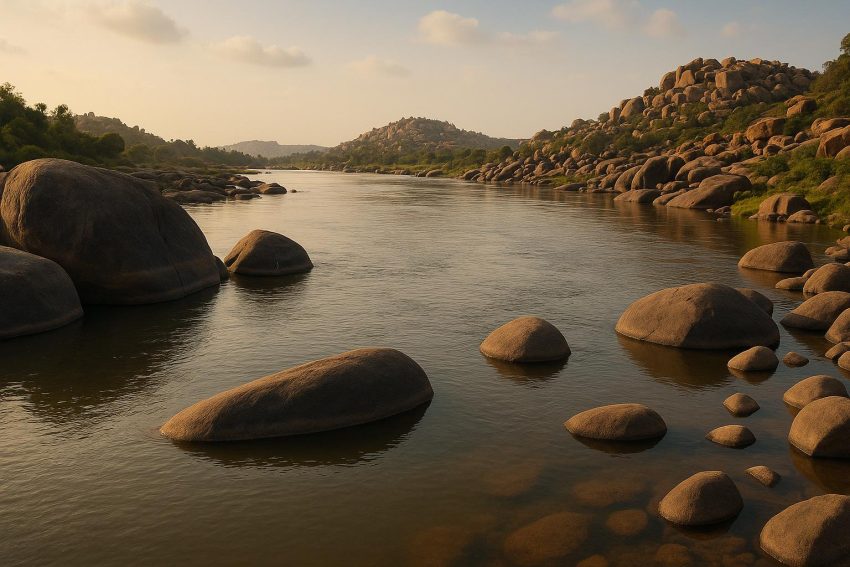
Overview of the Tungabhadra River
The Tungabhadra River holds a prominent position in the topography of Southern India, tracing its origins from the union of the Tunga and Bhadra rivers in the Western Ghats of Karnataka. This river is more than just a geographical entity; it is a lifeline that sustains various segments of human life and ecological diversity. The river’s contribution is multifaceted, encompassing agricultural support, drinking water supply, and hydroelectric power generation.
Geography and Course
The journey of the Tungabhadra River takes it through a variety of terrains and territories, including the districts of Karnataka and Andhra Pradesh, until it merges with the Krishna River. Stretching over a total length of approximately 531 kilometers, the river flows from densely forested regions, navigating rocky landscapes, and eventually passing through fertile agricultural plains. Such a diverse topography not only offers striking scenery but also acts as a cradle for an array of ecosystems. Each segment of the river’s course enriches the local biodiversity, fostering a unique combination of flora and fauna.
Tributaries and Catchment Area
Several tributaries play a significant role in sustaining the Tungabhadra’s flow. Notable among them are the Kumudvathi, Varada, and Bhadra rivers. Together, they form an extensive catchment area that spans parts of Karnataka and Andhra Pradesh, even extending into a small section of Tamil Nadu. This expansive catchment ensures the river’s continued vitality, serving as an indispensable resource for numerous urban and rural communities. The fertile areas along the riverbanks are crucial for agricultural operations, underlining the river’s role as an agricultural backbone.
Historical Significance
The banks of the Tungabhadra have been witnesses to a rich tapestry of history. Ancient dynasties and powerful kingdoms flourished here, harnessing the river for sustenance and growth. The most renowned of these is the Vijayanagara Empire, whose capital was strategically located near the river. The empire is celebrated for its prosperity, cultural achievements, and magnificent architectural accomplishments. Today, the site of the Vijayanagara ruins serves as a UNESCO World Heritage Site, offering insight into the historical and cultural affluence that once defined the region. These ruins are a testament to the advanced civilization that harnessed the resources of the Tungabhadra.
Modern Challenges and Conservation Efforts
Today, the Tungabhadra River faces an array of modern challenges that threaten its ecological balance and sustainability. Human-induced pollution from industrial waste, rampant sand mining, and the pressures of a burgeoning population are significant issues. These challenges not only imperil the quality of water but also the habitats that depend on the river for survival. Conservation efforts are paramount to restore and stabilize ecological balance. Sustainable water management practices are being promoted alongside pollution control measures. Community awareness programs are being developed to educate locals on the importance of preserving the river. Engaging communities in conservation efforts is a crucial step toward ensuring the longevity and health of the Tungabhadra River.
For broader insights into conservation initiatives across India’s river systems, please visit the Conservation Efforts Page.
The Tungabhadra River is not merely a geographical or historical entity. It is a dynamic, life-affirming waterway that continues to shape the landscapes and communities it traverses. From its historical significance with ancient empires to modern-day ecological challenges, the river’s role as a cornerstone of cultural and environmental heritage is evident. As efforts to protect and preserve this vital resource advance, the Tungabhadra River stands as a symbol of the delicate balance between nature and civilization. Through collective action and sustainable practices, it is hoped that this ancient river will continue to flourish for generations to come.